Waking Up from the Trance of Unworthiness

images-3

I am loving this Sounds True audio/video series on self-acceptance. For those who learn better by reading, here is rough transcript of the session with Tara Brach, Ph.D. I watched on one computer, paused it as I went, and dictated into my phone. I am breaking it into two posts, as it got a little long. You can still listen to this interview online here.

Tara’s first book Radical Acceptance helped me so much on a personal level, and I frequently recommended it to my clients over the years. Her newest book is called True Refuge: Finding Peace and Freedom in Your Own Awakened Heart. I have already read it once, and I highly recommend it.

In this episode, Tami Simon speaks with Tara Brach, PhD, clinical psychologist and founder of the Insight Meditation Community of Washington. Tara has been practicing and teaching meditation since 1975 and has led Buddhist meditation retreats at centers throughout North America. Her audio programs with Sounds True include Radical Self-Acceptance: A Buddhist Guide to Freeing Yourself from Shame and Finding True Refuge: Meditations for Difficult Times

Tami: What was happening inside of you, and in your teaching, that got you in touch with this idea, this need for radical self-acceptance?

Tara: I realized that my deepest suffering was a sense of not being enough, and when it was very bad, even a sense of self-aversion. I saw it in my students and clients.

I believe that the sense of not being enough is the most pervasive suffering in our society.

I had a friend in college who was reading “Learning to Be Your Own Best Friend” and I thought,  “Oh my gosh, I am the furthest thing from that.” And it was even more than that—it was that I didn’t trust myself.

We don’t recognize what I call “the trance of unworthiness”–how much we are trapped in the sense of falling short. And usually it’s on every front in some way. It’s a background noise that’s always saying, “How am I doing now?” Usually we find there’s a gap in how we think we should be and our moment-to-moment awareness. In that gap, we feel like we are always not okay.

noname-1A palliative caregiver told me that the number one grief of the dying is that they didn’t live true to themselves. They lived according to the expectations of others, but not the truth of their own hearts. At the end, there was the sense that, “I didn’t live this life true to who I am.”

If I did a show of hands and asked how many people speak unkindly to themselves, every hand would go up. But I think what we don’t realize is the overall sense we have that, “Something is wrong with me,” and how it pervades our day. It contracts everything. It’s a deep feeling of being flawed and deficient. It’s a trance that imprisons our moments in a way that we’re not aware of.

Tami: What do you think wakes people up from this trance?

Tara: The suffering. For example, if you’re in a relationship and you realize “I can’t really be close to anyone.” If someone got to know me, they’d reject me.

The pain is a wake up to explore how we begin to stop the war against ourselves.

So it’s the suffering that starts as the wake up.

Tami: How do we learn to trust ourselves?

Let me give an example. A woman came up after a class and told me that she didn’t deserve to accept herself because she was not being a good parent to her five-year-old. She was yelling at her all the time and being critical. It’s true, her behavior wasn’t ideal. But I asked the woman, “Do you love your daughter?” She said, “Of course, I wouldn’t be so upset if I didn’t love her.” Then spend some time getting in touch with that feeling of loving your daughter, I told her. That you can trust. (Editorial note: I believe it was implied in the way Tara described the story that eventually radical self-acceptance gives way toward aligning your behavior with what is in your heart.)

We can’t trust our ego self. It is unreliable, out-of-control, striving, and afraid. A true sense of trust comes from connecting with the deeper part of our self, and that takes paying attention.

noname-4Often the pathway to acceptance comes from pausing when we feel unworthy. Training in learning to pause when you feel the suffering is critical. Victor Frankl said, “Between stimulus and response there is a space. In that space is our power to choose our response. In our response lies our growth and our freedom. So the first step is to pause.

Next, you have to deepen attention–to get underneath the thoughts and determine what is going on in the body and in the heart.

You have to bring awareness to just how painful it is. I call it the sense of “Ouch!”

It’s helpful to put your hand on your heart. All you need is the intention to be kind to that place of suffering. You can’t manufacture feeling kind, but you can say, “I want to be able to be gentle to this place that feels so bad.” Then there’s a shift. The shift is a move from the unworthy self to a compassionate presence that is witnessing the unworthy self.

In the past decade I have had bouts of sickness that have been very humbling. I can feel irritable and self-centered, and then I start not liking myself for being a “bad sick person”. I think I’m not being spiritual in how I’m being sick. The Buddha called it the second arrow. The first arrow is being feeling sick, and then the second arrow is feeling unworthy because I’m judging myself for not being a good sick person.

In part two, Tara talks about how she deals with her own feelings of unworthiness, the importance of conscious community, and how to use the tool called RAIN.

Now I Become Myself

Now I become myself. It’s taken

Time, many years and places;

I have been dissolved and shaken,

Worn other people’s faces,

Run madly, as if Time were there,

Terribly old, crying a warning,

‘Hurry, you will be dead before-‘

(What? Before you reach the morning?

Or the end of the poem is clear?

Or love safe in the walled city?)

Now to stand still, to be here,

Feel my own weight and density!

The black shadow on the paper

Is my hand; the shadow of a word

As thought shapes the shaper

Falls heavy on the page, is heard.

All fuses now, falls into place

From wish to action, word to silence,

My work, my love, my time, my face

Gathered into one intense

Gesture of growing like a plant.

As slowly as the ripening fruit

Fertile, detached, and always spent,

Falls but does not exhaust the root,

So all the poem is, can give,

Grows in me to become the song,

Made so and rooted by love.

Now there is time and Time is young.

O, in this single hour I live

All of myself and do not move.

I, the pursued, who madly ran,

Stand still, stand still, and stop the sun!

May Sarton

may_sarton

The Long Winter

“There is no winter harsh enough to withhold the promise of spring.” – Karen Kaiser Clarke

I put my spring wreath on the door. I put my winter clothes away. I thought winter was over. But I was wrong. We have had 6 or more inches of snow today.

I thought I’d post a few of Greg’s pictures from this winter. (I use this blog kind of like a scrapbook. I had all my 2012 entries made into a book for only about $30).

I spent the day drinking hot chocolate with the dogs on my lap. I also wrote a blog post for Psychology Today. It’s called A Simple Way to Put the Spark Back in Your Relationship. I don’t know why, Psychology Today is sometimes so slow to load, but if you’re patient, you can read it 🙂

Hopefully next time I’ll be posting Spring pictures!

DSC_0010

DSC_0151DSC_0011DSC_0034DSC_0116DSC_0009DSC_0096

The First Race

My brother, Bill, with my parents after the race.

My brother, Bill, with my parents after the race.

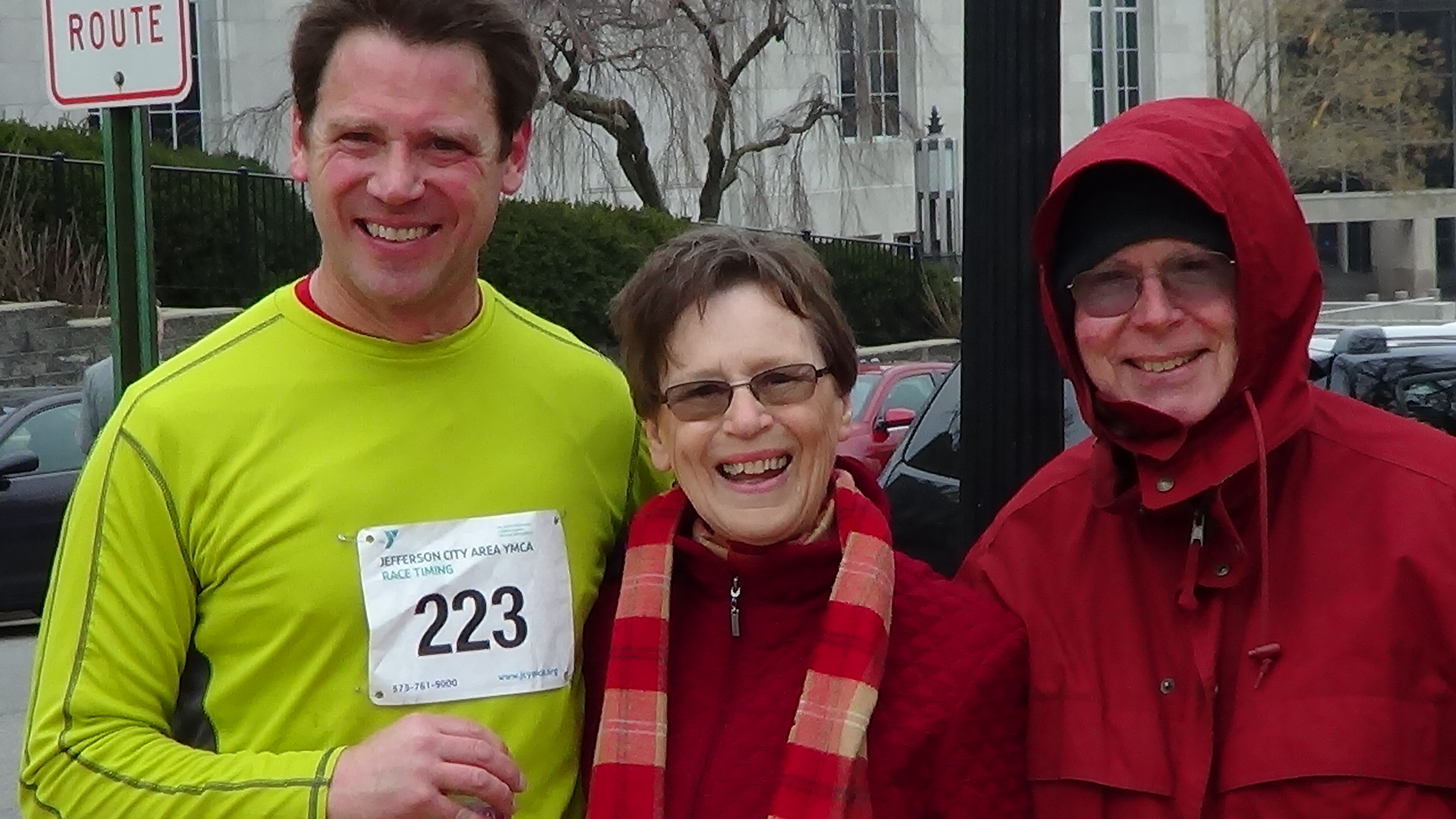
My brother, Bill, was diagnosed with Parkinson’s Disease several years ago. In late November 2012, he underwent brain surgery to implant deep brain stimulators in the hope that these would help control his symptoms. If you haven’t already, you can read/see more about Bill’s amazing story in this blog post, My Brother, My Hero, My Friend.  Two months after the surgery, the doctor gave Bill permission to resume exercising. Just seven weeks later, Bill competed in a 5K race in Jefferson City, MO. He covered the hilly terrain in 29:44.

Bill enjoys running and says it is actually easier to run than it is to walk. He sets concrete, achievable goals. He says he likes to focus on running because “Parkinson’s is too big.” His next running adventure is in 3 weeks: he’ll be on a marathon relay-team in St. Louis.

He is feeling much better since the deep brain stimulation (DBS) surgery. He is back at work full-time. He says he feels hopeful and he sees that he has his whole life ahead of him. I’ve been doing a lot of video interviews with him, and will post more as I can. For any friends and relatives reading this, Bill has said numerous times that he couldn’t have done this without all of your love and support!

Check out Bill’s running story in this short video:

A big shout out to my son for helping me (A LOT) with this video.

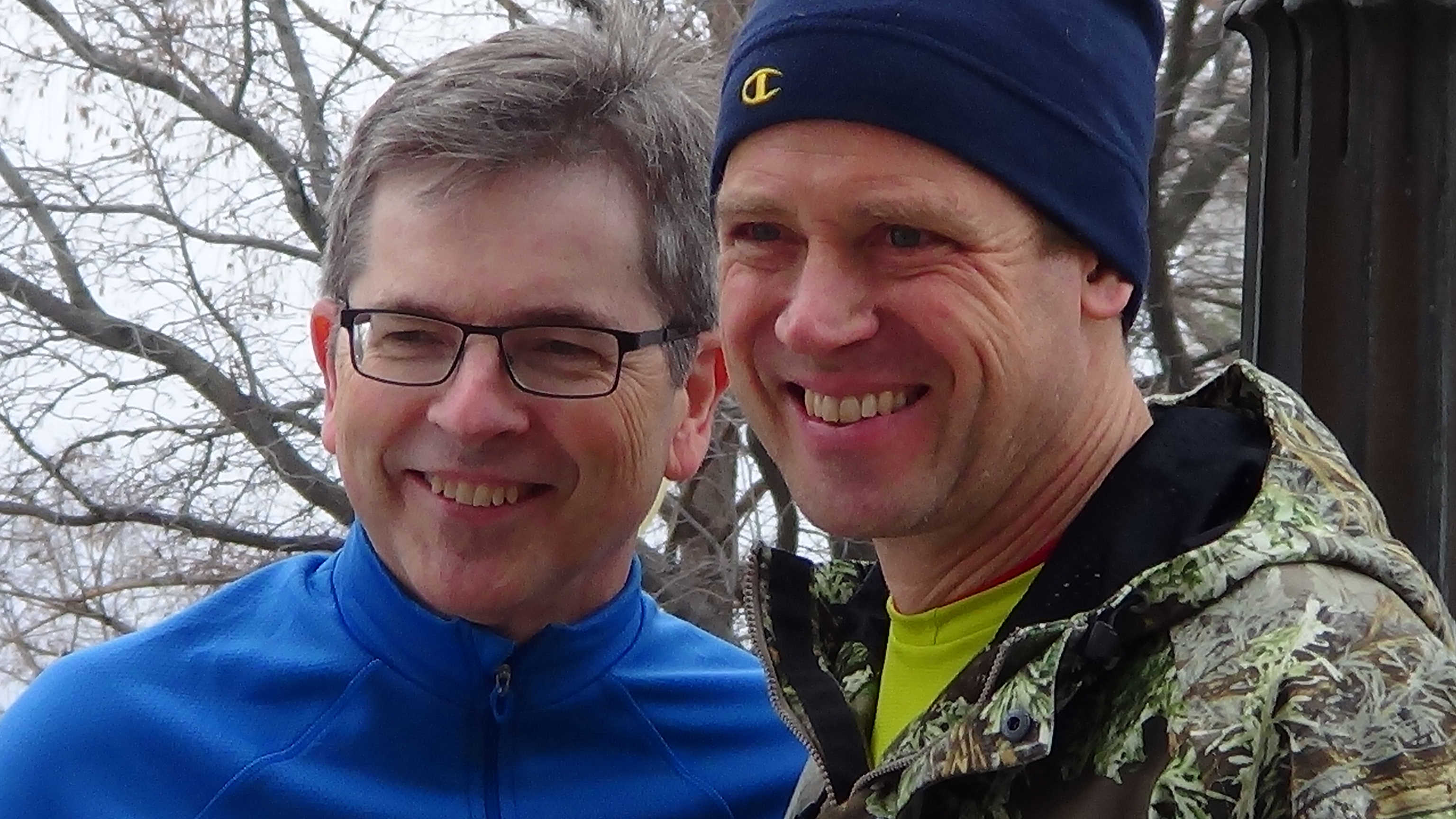
Here’s a picture of my husband, Greg, who also ran, the race, with Bill.

Greg and BillMarch 17, 2013

Greg and Bill
March 16, 2013

Kindness Is the Means and End

Sounds TrueThese are my notes from Session 3 of The Self-Acceptance Project at Sounds True.
In this episode, Tami Simon speaks with Geneen Roth, a writer and teacher whose work focuses on using addiction as a path to the inner universe. Geneen is the bestselling author of Feeding the Hungry Heart, and with Sounds True has created the audio learning course When Food Is Food and Love Is Love.

Tami asked Geneen to talk about working with the self-critical voice in our head.  Here are the main points she made.

Step One: It’s really important to normalize it. You’re not alone. Everyone has that inner voice. Some people’s inner voice is just a lot more vicious than others.

Step Two: Disengage or dis-identify with the critical voice. Say, “Oh, there it is again.”

Action: Write out a list of 10 criticisms that you’ve said to yourself in the past half hour. Then say these out loud in the tone of voice that you hear them in your mind. And say it starting with “You.” Such as “You are so stupid.” Or “You are so fat.”  People are shocked when they hear it said that way. This helps you to step back and disengage.

The first step is awareness, because only with awareness can you take action.

1.  The action can be asking your self, “Is this true?” (Is it true what the voice is saying?)

2.  The action can be agreeing with the voice with some type of humor. Example: “You think I ate a lot for lunch. Just wait until you see what I’m going to eat for dinner.” (It’s a way of disengaging.)

3.  This next idea works for some people but not others: You tell the voice to shut the hell up!

Tami pointed out that some of the other presenters have suggested that the inner critic has some function (such as self-protection) and asked Geneen to comment. Geneen said the problem is the moral judgment that so often goes along with the inner voice. When you say, “Hmm. You gained 5 pounds. I wonder what that is about” is a whole a lot different than, “You’re such a failure. You gained 5 pounds.”

The moral judgment that is often tied up in the inner voice blocks you from having any type of clarity or curiosity; it just makes you feel diminished, small and like you want to hide.

People are somehow hypnotized with this belief that if we somehow shame ourselves enough we will end up to be happy, loving, self-accepting people. I ask them, “How does that work for you?”

Geneen RothGeneen has done a lot of work with compulsive eating and body image, and Tami asked her to talk some about that. Her basic points:

If you shame and deprive yourself into losing weight you will end up as a shamed and deprived person who may have  thin hips for about 10 minutes. But the shame and deprivation will lead you to overeat and you’ll gain it back.

Does shame and punishment and fear and guilt work at any level for any kind of long-lasting change? (No.)

The bottom line: Kindness is the name of the game.

Curiosity is the Key

medium_7380729644These are notes I took from Monday night’s session of  The Self-Acceptance Project presented by Sounds True. It’s not a word-for-word transcription, but it will give you the basics. It’s still online and free, so check it out.

In this episode, Tami speaks with Dr. Harville Hendrix, the creator of Imago Relationship Therapy. Dr. Hendrix is the author of the classic book Getting the Love You Want.

I have never read any of Dr. Hendrix’s books, so I’m not as familiar with the concepts he discusses. It was very interesting to listen to him. In some ways, he sounded very behavioral, talking about gathering data and letting the data change your beliefs about yourself. In other ways, he sounded psychodynamic, talking about excavating the self and looking back into your childhood to see where self-limiting beliefs may have originated.

My notes are in order of what he said, but they don’t seem as organized as those I took while listening to Kristen Neff, Ph.D. (click her for those, Compassion and the Self-Critic.) I may come back to this and try to develop this better, but for now I just wanted to get them out there (and not be perfectionistic!).

*********

The important thing is to think about is what function the negativity serves, and to process that information. Everything we think and do serves a function in our psychic economy. He believes there is some sort of causality in whatever we do. He gave an example of a graduate student who was working on a dissertation. The dissertation was actually finished and the person had received positive feedback from people on his dissertation committee. It is ready to turn in (and has been for months) but the person waits and keeps saying it’s not good enough. The self put down, the statement of  it’s not good enough, prevents the person from experiencing any relational transaction with the professor in which his fears might come true. He is fearing the possibility of negative judgment. Now where does the self put down come from? Usually people can trace it to something early in their lives. Ask yourself other questions such as “What is it related to?” or “What is it protecting your from?”

The second thing is to move out of the limbic system of the brain—the part of the brain where we are always looking for bad stuff to happen. There is a neurochemical response in which cortisol is released and  permeates the sensory system. This makes you feel like you’re in a dangerous state. We have to move out of that system and accumulate data and assimilate the data that is not  congruent with your beliefs. He said that positive affirmations never helped him. The data helped him.

Positive affirmations never helped me. The data helped me.

He also said there is a connection between the quality of our relationships and how we treat ourselves. He said reality is relationship. Reality is connection. If we don’t have a sense of safety in our relationships it’s very difficult to have internal safety.

He also talked about the power of ambivalence. He said when we are in the state of ambivalence our brain doesn’t know what to do. When it’s not engaged in a directed activity, it gets anxious. So ambivalence feeds on itself. When we move from the state of ambivalence to commitment, our brain knows that it has to go to work. If you want to grow you have to become intentional. You have to get on the train and then the brain engages. You collect data and then sort the data. The ambivalence protects the person from some fearful imagined outcome.

He talked about letting love in and rejecting compliments:

1. If I let in the compliment that I did well in, it will establish expectations that I will always do well, and that will be too taxing.

2. People are always insincere.

3.  If I let love in, it will cause me to have to release the architecture of my self-concept.

Again, you have to understand where the defense comes from, and then collect data over and over again in small amounts until you can’t deny the evidence anymore. At some point this will release the defense.

When we change our self-configuration, we have to be open to being a “bigger” person. This opening up can create anxiety.

In neuroscience terms, the brain likes to know what is coming next. If we let love in, we have to be willing to live in mystery. When we are aware of our connection with the rich tapestry of life, we live in joy. When we are not living in joy, something has triggered our anxiety and makes us experience ourselves as separate.

Compassion for the Self-Critic

Sounds TrueThese are notes I took from last night’s session of  The Self-Acceptance Project presented by Sounds True. It’s not a word-for-word transcription, but it will give you the basics and a feel for Kristin’s warm tone. It’s still online and free, so check it out.

Session 1: Compassion for the Self-Critic

In this episode, Tami Simon speaks with Dr. Kristin Neff, an associate professor of Human Resources and Culture at the University of Texas at Austin. Kristin is the author of the book Self-Compassion and the creator of the Sounds True audio learning course Self-Compassion Step by Step. She and her family were also the subjects of the 2009 documentary and book The Horse Boy.

Why is self-compassion getting so much more attention these days?

1. Societal shifts – the false promise of the self-esteem movement.

2. A general shift – a recognition that the heart has to be an equal player along with the mind.

What is the difference between self-esteem and self-compassion?

Self-esteem is a positive evaluation of oneself. Unfortunately, the way we have gotten our self-esteem has been by comparing ourselves to others, and it’s not seen as good enough to be average. So everyone has to be above average, and there’s obviously a flaw in that logic.  An unintended consequence of the self-esteem movement in the schools has been creating a generation of narcissistic and entitled children.

In contrast, self-compassion is not about evaluating yourself positively. It’s about how you relate to yourself.

Why are we so self-critical?

Self-criticism taps into the threat/defense response. This system is hard-wired and worked great when the threat was a lion running after us. The system is designed to protect us and keep us safe. But when the threat is to our self-concept, self-criticism does not work well. When you view yourself as the problem (I can’t believe I gained those 5 pounds back, I should’ve gotten an A on that test) the reptilian brain kicks in and attacks yourself, thus the self-critical self-talk.

Self-compassion moves you from the reptilian brain to the mammalian caregiving system of tending/befriending. Mammal’s young are designed to attach closely with the mother to stay safe. Mammals respond to warm, soft touch and a soothing voice. So a great self-compassion technique is a physical gesture of affection, such as putting your hand on your heart and saying words to yourself in a supportive, soothing tone. Research is showing that the tone of voice in how we talk to ourselves is very important.

We have to let go of self-criticism as the problem, though. We have to have compassion for the self critic. Self-criticism comes from a desire to keep ourselves safe. So we first have to have compassion for the critical voice. The self-critical voice needs to be heard, and then paradoxically it can quiet down. Then you can bring in self-compassion techniques. You can say to  yourself,  “I want to keep you safe too, but I want to do it in a more effective way.”

You talk about self-compassion having three components. Can you talk more about that?

Yes, the first component is self-kindness, which we just discussed–talking to ourselves in a kind, gentle way and offering ourselves the support we need.

Another aspect of self-compassion is recognizing our common humanity. In essence, acknowledging that everyone is flawed: this is part of the human experience. It helps to remember that you’re not alone in what you’re feeling. Isolation also has an evolutionary explanation. If you get disconnected from the group, you get eaten by the lion…so it’s very scary! That’s why we need to remind ourselves that suffering, being flawed and imperfect, is a part of life.

The third component is mindfulness: being able to recognize in the moment when you’re suffering. It’s amazing how much negative self-talk goes on just under your awareness. We teach formal meditation, but research is showing that the informal self-compassion techniques we’re teaching are just as effective. Self-compassion isn’t that hard. We have these skills that we use for our friends or our children. We just have to remember to do it for ourselves.

Why do we have such trouble with being compassionate with ourselves?

There are really two very closely related reasons. One, when we criticize ourselves, we reinforce the illusion of control. Self-judgment says that if only I would have tried harder, things would’ve worked out. It’s scary to admit how little control we sometimes have. Two, we really believe that we need self-criticism to motivate ourselves. This is the number one reason people give for not wanting to be self-compassionate. They are afraid they’ll be lazy or not do what they need to do. However, when we are in a self-critical place, this is the worst possible mindset in which to do our best.

In conclusion, Kristin led viewers in a “Self-Compassion Break.” 

Think of something you’re struggling with. Assume a self-compassion posture, such as the hand on the heart. Say to yourself in a kind tone of voice, “This is a moment of suffering,” or “This is really hard right now.” – “Suffering is a part of life; I’m not alone in this. Other people feel the same way.”—“May I be kind to myself in this moment and may I give myself the kindness I need.”

I just signed up for this. It’s free and it looks great!

My favorite way to explain self-compassion

medium_280999386My favorite way to explain giving yourself compassion is the analogy of how you would treat a small child. Let’s say your child is learning to walk. After a few wobbly steps, do you criticize him or her and say, “Look at you. You’re so clumsy. What’s wrong with you that you can’t walk yet.”? Of course not. You offer encouragement. You’re excited! You might even clap your hands in delight.

Now let’s say your child wants to eat candy for dinner. You set limits and say, “no” because only eating candy will likely make your child feel sick and it simply isn’t healthy. People mistakenly think that self-compassion always means saying “yes” to yourself. Sometimes it means saying “no”–but doing so with kindness. It’s important to remember that self-compassion involves nurturing and limit-setting.

Here’s another post I wrote about self-compassion and limit setting.

Here’s an interview I did with Dr. Alice Boyes over at her blog, In Practice, at Psychology Today on The Self-Compassion Project.

photo credit: http://www.flickr.com/photos/tammra/280999386/  via Photopin, CC

Self-Compassion Techniques I Love

Locked HeartsI love these techniques because they’re quick and easy, and they make a difference in my day.

1. One technique I use daily is a gentle touch on my skin (maybe touch my forearm with my other hand) while I say something reassuring to myself. The touch actually releases oxytocin and sets off a calming response in the body. I discretely do this at work when I’m stressed (at home I may give myself a big hug!)

2. I often combine the self-compassionate touch with a phrase or self-compassion mantra, such as: “This is a moment of suffering; suffering is a part of life; may I be kind to myself and give myself what I need.” I have tried meditating and do it sometimes. I’m not very consistent, but I’m going to keep trying.

3. I do a lot of informal mindfulness practice. I never used to take breaks—it was always work, work, work. Now I go outside and simply appreciate the beauty around me. This helps me connect with a greater good, and I end up feeling softer and gentler with myself. I have really gotten into bird watching!

4. I write myself little “love notes” to keep in my purse. It’s usually just a few quick sentences I want to remember during the day to stay focused on self-compassion.

This was part of an interview I did with Dr. Alice Boyes. You can read the whole interview here.

If you haven’t already liked my Facebook page, you can find it here. (It’s also on the sidebar, but no one looks there!)

You can also follow me on Twitter.

Photo: Public domain photo by Peter Griffin.