A Horse with No Name

I traipsed through the long hallway with my large white envelope under my arm. I’m  seeing yet another doctor, carrying these films that are supposed to reveal what is going on inside of me. I open the door and see several people sitting there, with their own white envelopes. They look up briefly with a silent, knowing glance. I check in with the receptionist, my hand trembling a bit as I turn over my MRI. I notice for the first time that the envelope is marked “MISCELLANEOUS.”

But this story isn’t about me. Well, not only about me.

It’s been an exciting week for The Self-Compassion Project. Ashley Hasty’s Paint the Town Purple day was a huge success. Her Facebook Status 11 hours ago read: “Thank you all, from the bottom of my heart, for your support in celebrating and honoring those with Crohn’s Disease. We had 16 photos posted from at least 6 different states! We gained about 20 new “likes” on this Facebook page and there are 150 people talking about this project on Facebook! We are definitely taking steps toward raising awareness about Crohn’s, building a supportive community, and ultimately finding a cure!”

Toni Bernhard’s interview on her book How to Be Sick and coping with chronic illness reached the most people ever on this blog. One of her supporters said it so well: “A gentle and penetrating interview in which Toni reveals again her authenticity as a human applying wisdom to a senseless sickness. She demonstrates over and over again, the profound message of acceptance by exploring its mysteries, its boundaries, its illusions and strength. As Jack Kornfield says of mindfulness, ‘simple but not easy’. We are fortunate to have Toni.”

Yesterday I wrote about cancer, and about how everyone has a unique journey in their recovery process.

Today, I’m thinking about names, and how important they are. I don’t know about you, but when someone calls me, “Barb,” I feel seen, really known. It’s a little thing, but it makes a difference.  (Much better than “Hey you!”). In the same way, having a name for a condition, a diagnosis, can make people feel better. On the one hand, being told you have a horrible disease is frightening. But for the first time, you don’t feel like you’re crazy. There’s a legitimacy to having a name for your symptoms. Having a name for the problem also holds the promise of treatment, maybe even a cure. Once you have a diagnosis, you’re immediately part of a group of people in the same boat. You can rally together and be a team. And to top it all off, you get a colored ribbon!

So I’m thinking about all the people who aren’t sure what’s wrong with them. They’ve been to specialists, had all the tests, and carried their MRIs down many a hallway.  I  wish there was a ribbon for people like us. I even went to a paint store to look at paint chips, in hopes of finding the perfect color name for our ribbon. The best one I found was “Mysterious Mauve.” It’s a subtle mix between gray and purple. Beautiful.

Greg was reading over my shoulder and said this made him think of the song by America, “A Horse with No Name.” Yep. That’s going to be the name of this post.

Today, know that I believe you. I know you’re not crazy. Doctors do the best they can, but they’re human, too. They make mistakes. They don’t have all the answers. They don’t always have a name for what we have, but that doesn’t make it not real. As Toni said in her interview, “The single most important thing we can do is to be kind to ourselves.”

Have a restful weekend!

Cancer: No Single Path to Recovery

A winding road in Budapest
photo by Peter Sikori via Flickr

(I wrote this for another publication, so the tone is a bit different. I thought some of the ideas might resonate for people.)

Popular magazines tell readers how to live with cancer by having a positive attitude, attending support groups, and managing stress. While these strategies can be important, not everyone will follow the same path in their journey. In my counseling work over the years, I’ve learned there’s no one right way to cope, and variety in experience is the norm.

 Not Everyone Wants to Wear Pink

Now if I were diagnosed with breast cancer, I’d be tempted to use it as an excuse to go on a shopping spree to buy anything pink and sparkly. Yet there are plenty of people who don’t want to wear clothing and jewelry advertising the fact that they have cancer. Take  Amy, for example. When she was diagnosed with breast cancer, a good friend gave her a T-shirt and baseball cap with the familiar pink ribbon logo on it, joking that she might need the cap when she lost her hair. Although Amy knew the gesture was well meaning, she was taken aback. She wasn’t ready to announce her cancer to the world. On the other end of the spectrum, another woman I know got a tattoo of a breast cancer ribbon and posted a picture of it on Facebook!

Positive Thinking Has Its Pitfalls

I’ve always assumed if I had some sort of life-threatening illness like cancer, I’d be doomed because there’s no way I’d have the requisite “good attitude.” Despite reading Norman Vincent Peale’s The Power of Positive Thinking when I was a teen, I’ve never quite gotten it down. We’re inundated with the notion that we have to find the positive in every experience. Fortunately, I think it’s a cultural myth that you have to “fight” cancer with positive thinking. From my take on things, positive thinking can backfire. If you’re so busy trying to look on the bright side, you may deny the reality that having cancer is scary. Experiencing a range of feelings including shock, fear, sadness, and even rage is normal. It takes a lot of energy to deny the reality of your feelings, energy that could be better used elsewhere. My advice? Allow yourself to feel it all, and don’t judge yourself if sometimes you simply need to whine and complain. It’s really okay to have a pity party sometimes.

Support Groups Are Optional

Another woman, Michelle, wanted to do everything possible to complement her medical treatment. She had read research that support groups were an important part of the recovery process, and she went to several meetings. Each time she left feeling worse than before. One of the most caring and sensitive people I’ve known, she absorbed all the painful feelings in the room. She also berated herself for any “self pity” she felt, when others clearly had worse situations. In addition, some people are naturally too reserved and private to benefit from support groups. I’ve spent much time reassuring these people that it’s okay— they don’t have to go to a support group. While it’s beyond the scope of this article, the research is actually conflicting on the subject. In 1989 there was a landmark study that argued for the curative power of support groups. More recently, though, systematic reviews of the literature have found there were problems with the research. The bottom line? Do what’s best for you, and keep in mind there are many different ways to get the support you need.

Avoid New Age Guilt

We’ve all heard about the mind-body connection—how stress can play a role in every-thing from the common cold to heart disease. Bob came in every week and said, “Are you sure I didn’t get cancer because of all the stress in my life?” Last year I took a course called Mindfulness and Psychotherapy, taught by professor of psychology at Harvard Medical School, Ron Siegel, Ph.D. An important thing I learned was a concept he called New Age guilt. He said that in our zeal to use our minds to transcend pain and suffering, we tend to blame ourselves for everything that goes wrong with our bodies. Dr. Siegel reminded us of what happens to even great meditation masters: No matter how wise, skillful or compassionate they are their bodies fall apart in the end.

Give Yourself a Break

Life is hard. Add cancer into the mix and well, it can seem pretty unmanageable. This isn’t the time to put more pressure on yourself. You don’t have to be a perfect cancer patient—doing things a certain way. You’ll get lots of advice, and you need to judge for yourself what will be helpful. Sometimes positive thinking can perk you up; other times, it is a needless drain. Sometimes you want the support of other people; other times you need some alone time with the cat on your lap and your favorite music. And what you feel like doing one day may be completely out of the question the next. Remember to be gentle with yourself. Life is lived one day at a time.

Coping with Chronic Illness…Compassionately

Although Toni Bernhard’s book is called How to be Sick, I found it a lovely and poignant read on how to live, regardless of one’s health status.

Toni was a law professor at the University of California–Davis when she became ill on a trip to Paris in 2001. At the time, she was diagnosed with an acute viral infection–“the Parisian flu” they called it. Unfortunately, she never got better. Amazingly, she wrote How to be Sick from her bed using a laptop. The book won the 2011 Gold Nautilus Book Award in Self-Help/Psychology and was named one of the best books of 2010 by Spirituality and Practice.

Toni has not recovered her health, but her spirit remains strong. She writes regularly for Psychology Today and generously donates her time and wisdom. I was so excited when she graciously agreed to be interviewed for my blog.

When do you accept your pain or health condition as is, and when do you keep trying new approaches?

In my opinion, we have to do both. Acceptance is not the same as indifference or resignation, which carry aversion with them. Acceptance to me is an opening of the heart to the difficulties we face and being able to say, “This is how things are right now” even if “how things are” is difficult. I try to accept how I am AND continue to pursue new treatments. But I’ve learned a lot in the past eleven years about having to pick and choose skillfully among those treatments.

First, of course is the cost. I’ve spent so much money on failed treatments that it’s been a strain on our budget. At the point when the strain outweighs any benefit I can foresee, I stop (I did this recently with the third Chinese herbalist, even though he’s one of the most respected herbalists in the world).

Second, I’ve had to learn to not just jump at every treatment option, but think about it carefully and see if it’s at all reasonable. I used to try everything. Now, I’m very careful.

So, you have to find a middle way — but to me, acceptance of how you are now AND continuing to pursue treatments are not in conflict with each other.

I have also gone through periods where I’m just too exhausted to keep an eye out for treatments. I just retreat, as if I’m in hibernation, and that seems to be good for me sometimes too.

How do you have self-compassion when you’re feeling sick and tired?

I always tell people that the single most important thing they can do is to be kind to themselves. I look at it this way. We control so little in our lives, but the one thing we can control is how we treat ourselves. I see no reason for us not to be as kind and gentle with ourselves as we can be. It’s not our fault that we have health problems. We’re in bodies and they get sick and injured. It will happen to everyone. This is how it’s happening to us. I’ve had so many people write to me and say the single most important thing they got out of my book was to give up the self-blame and forgive themselves for being sick or in pain. Many people have said they didn’t even realize they hadn’t forgiven themselves until they read How to Be Sick. Those emails always touch me so much — just to know I’ve been of help to them.

I really think it helps to speak to yourself with words of self-compassion — to find just the right words for the moment: “It so hard to be sick yet another day.” I said to my husband yesterday, “I’m sick of being sick.” But, instead of “feeding” that thought with stories I spin: “I’ll never get well.” “I’ve been cheated of eleven years of my life,” I’ve learned to just let myself feel “sick of being sick” and speak to myself kindly about it. It’s natural for that emotion to arise so I try not to make it stronger by feeling it with worse-case-scenario stories. Instead, I’m just gentle with myself until the emotion passes — as it will.

How do you deal with uncertainty and unpredictability that goes along with chronic illness?

I use what I call “weather practice,” which I describe in my book. It was inspired by the movie, The Weather Man, which takes us inside the meteorologist’s craft where we see that the weather is unpredictable and ever changing. I use this as a metaphor for life. It helps me hold painful physical symptoms and blue moods more lightly. I can’t predict when they’ll arise but I know for sure that they’re just blowing through, like the wind. It makes it easier to wait them out. It applies to what happened yesterday when I suddenly got that “sick of being sick” feeling. I wasn’t expecting it to descend on me but it did. So I let it be there, knowing that it was an arising and passing mood. Sometimes, I do something particularly nice for myself — put on a movie — until the mood passes.

I also like to remind myself that uncertainty and unpredictability can work in my favor. We assume they’ll be a source of stress, but they could also mean that something unanticipated but wonderful is just around the corner. So, I like to remember that these two can be our friends.

How do you pace yourself (not doing too much on good days, then paying for it later)?

Now you’re asking about something I’m not very good at doing. I get off the hook a bit because my symptoms are pretty consistent from day to day — relentless you could call them. So for me, it’s not a question of overdoing it on a good day v. a bad day, but of overdoing it when something I enjoy is going on — like my son and his family coming up for the day from Berkeley. I try to pace myself but usually overdo it anyway. Then what do I do? Self-compassion again! There are some limits to which I can’t stretch myself, but visiting in the living room for longer than I should is one of them. And so I do it, and accept that paying the consequence was worth it.

How do you deal with anger?

I’ve been angry about my inability to be with my family more than I can. Sometimes, I do have to leave the living room and it’s hard to listen from the bedroom to all the laughter and good times I’m missing. But I’ve learned that getting angry doesn’t get me anywhere. It certainly doesn’t allow me to visit longer. All it does is increase our suffering.

Anger will arise. Don’t be upset with yourself for getting angry. It’s a natural response to your situation. The question is, how can you respond skillfully to it so as to minimize the suffering it causes. Here’s what I do. I note that it’s there, often by labeling it, “Feeling angry” or “This is what anger feels like.” I don’t get angry at myself for being angry — that’s just a judgment that makes the anger worse. In fact, I try to treat it like a guest I know well — an uninvited one perhaps, but still a guest. I find if I do this, it doesn’t fester and grow stronger. Then I look for what’s behind the anger. Almost always it’s some form of desire — I’m not getting what I want or I’m getting what I don’t want. It’s that “want/don’t want” I refer to in the book.

Just finding the desire that’s the source of the anger often loosens its grip on me, because I know, deep down, that we simply can’t fulfill all our desires and that if I continue to be angry about it, it will only make me more miserable and, in the end, won’t get me what I want. So, with this awareness that anger is present and that it’s because of a desire I can’t fulfill, I just let it be. Just sit with it. Just let it be until it gradually changes, weakens, and passes out of my mind. This is one of the ways in which the law of impermanence can be our friend!

Again, I’m so thankful to Toni for sharing her wisdom.  

To soak up more of Toni’s inspiration, click here.

A Passion for Purple

I don’t know if Ashley Hasty’s favorite color has always been purple, but she sure shows a passion for it now.

Last year Ashley wore the same purple dress each day of the month of April to raise money and awareness for Crohn’s Disease. Purple is the official ribbon color for this incurable condition in which a person’s immune system attacks the colon. Ashley was diagnosed with Crohn’s Disease in 2010. This came after years of her suffering abdominal pain, not really knowing what was wrong. She went through numerous tests, procedures, and hospitalizations before finally having a colon resection.  Ashley knew first hand that Crohn’s Disease is not a glamorous problem. No one likes talking about their bowels! She knew how alone she had felt, and she wanted to do something to help others.  She was in a Ph.D. program in Textile and Apparel Management at the time, and she decided to bring her fashion expertise and social media savvy together to form “The Purple Dress Project.”

Ashley accessorized her purple dress differently each day, took pictures, and wrote about the experience on her blog. She generated quite the media storm in Mid-Missouri and was featured in most print publications, in addition to making several TV appearances. She’s since moved to Indiana (where she teaches textiles at IU), but is continuing the project there. This year, she switched things up a bit and decided to get other people wearing purple dresses–smart girl! She proclaimed Tuesday, April 24, 2012 as Paint the Town Purple Day. Supporters are to wear a purple dress and post it to her Facebook wall.

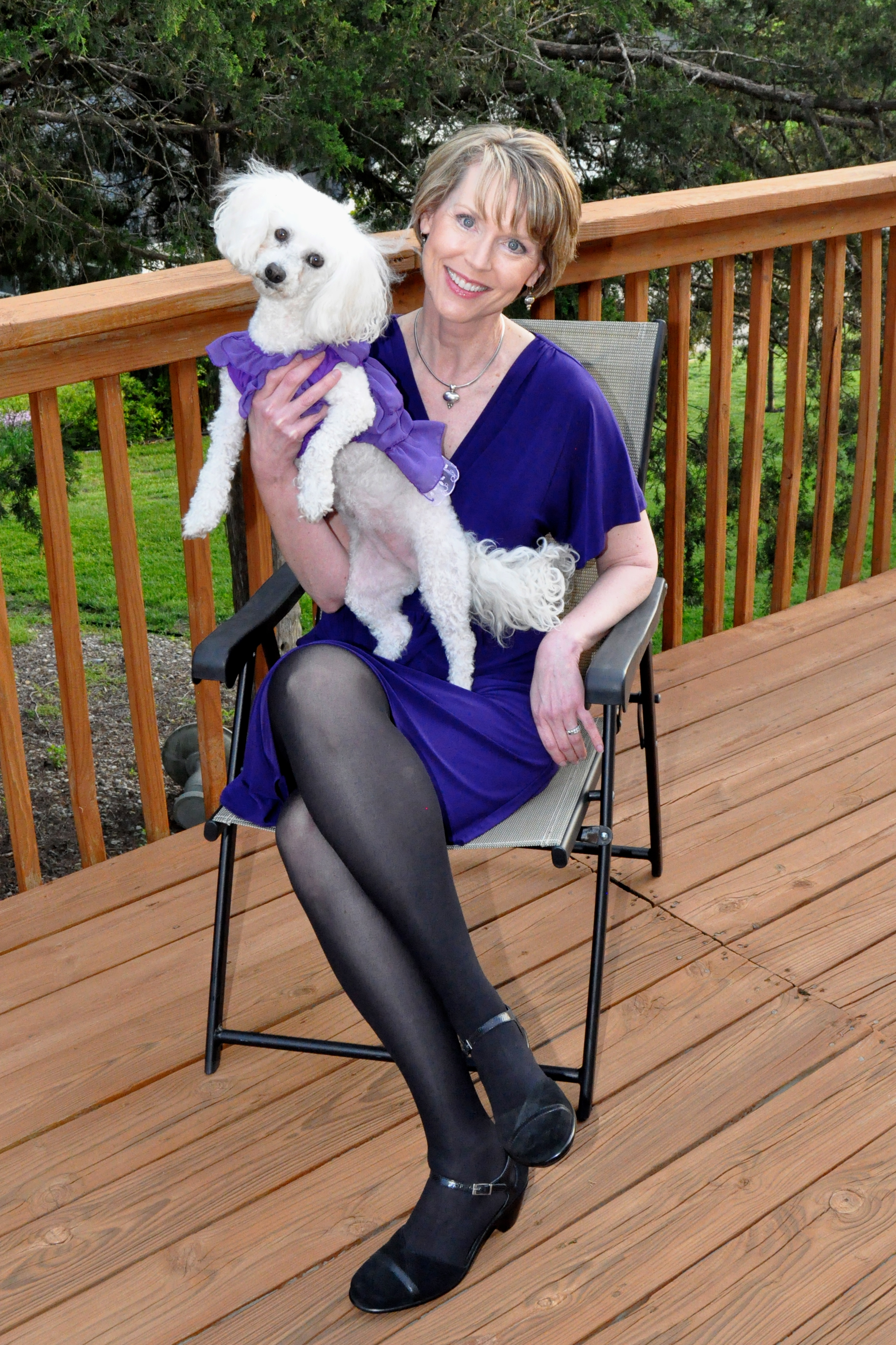
Ashley’s mother is my neighbor, and she was also my son’s fifth grade teacher. They’re a great family and I was eager to help out, especially since it involved shopping for a purple dress! For any fashionistas out there, the dress I’m wearing in my photos (below) is an Evan-Picone, bought on a clearance rack for $30. I was extra excited when I found a purple dog dress at Target, which I just had to buy for Lily, my Bichon who happened to get a bad haircut the day before. 

You can see more photos of Lily and me on my Facebook page. I’ve also made a donation to The Crohn’s and Colitis Foundation of America. I know we all get asked to donate to many worthwhile causes. Ashley makes it clear that no amount is too small. To donate to The Purple Dress Project/CCFA, click here. And if you can’t donate, that’s fine, too. Just reading this and being more aware of this disease will make Ashley’s day.

For more information on these disorders, check out this site: Crohn’s and Colitis Foundation of America (CCFA).

To follow Ashley’s journey, and to see fun pictures of people (and dogs!) wearing purple, click here.

Perfectly Imperfect

We live in perfectly imperfect bodies. While they do amazing things, they don’t always cooperate with our plans. We get a cold before an important presentation. Our back goes out before a vacation. Or worse yet, we develop a chronic illness that seriously disrupts our lives.

I’ve shared some of my personal struggles with chronic pain on this blog, and I’m working diligently to be more compassionate to myself, regardless of what I can or can’t do on any certain day.

This week has a theme. And for regular readers of my blog, you know I like themes! My inspiration and timing of the theme comes from Ashley Hasty, who I’ll write more about tomorrow. She has Crohn’s Disease and has a unique project that runs through April to raise awareness and money to support research into the illness.

This week I’ll be exploring questions such as:

  • How do we make sense of suffering?
  • How do we find hope when it feels like there is none?
  • How do we be kind to ourselves when we feel sick and useless?
  • How do we find meaning in the mess? (I also like alliteration)
  • How can we reach out to others?

So, here’s the schedule:

Tuesday: A Passion for Purple (featuring Ashley Hasty’s story)

Wednesday: Coping with Chronic Illness…Compassionately (featuring an interview with Toni Bernhard, author of an award-winning book called How to be Sick)

Thursday: Cancer: No Single Path to Recovery, a piece I wrote for another publication, but it fits in with the theme, so I’m going to reuse it 🙂

Friday: To be announced… I have ideas swirling in my head. The title will likely involve a color name. (I’m thinking “Mysterious Mauve” or “Uncertain Gray”)

I’m feeling a little giddy thinking about color names, so I’d better go for now. See you tomorrow!

A Shy Person’s Secret Wish

Have you seen this e-card zooming around the Internet lately? While I wouldn’t say it describes me perfectly, there’s something about it that rings true. I relate to the tension of being naturally introverted, yet caring deeply about things and wanting to share my voice with the world. I’ve also had this secret, somewhat silly wish to be a model. I’ve always known I’m photogenic, and I enjoy having my picture taken (if I’m in the right mood).  What a contradiction–a shy person who wants to be a model. No wonder I don’t understand myself sometimes!

When I saw there was a model search contest sponsored by More magazine, I decided to enter. I had a photo (the one Greg took of me for this blog). But in addition to the photo, you had to write an essay on “what makes you feel beautiful, inside and out.” This was a major sticking point for me. The truth is, I don’t always feel beautiful. Sometimes I feel anything but beautiful. So should I even enter this contest? I wrestled for days with my essay, and almost called it quits. In the end, I like what I wrote. You can read it here.

The winner gets a trip for two to New York, a professional photo shoot, and will be featured in the print edition of More magazine. I don’t expect to win, but I’m glad I entered. I’m also glad I decided to tell you about it 🙂 I almost didn’t.

Obsessions and Preoccupations

This was a fun exercise for the class I’m taking, Alchemy: The Art & Craft of Writing.  In order to help generate writing ideas, we were to come up with a list of obsessions and preoccupations. Here’s mine in no particular order:

  • Kelly Rae Robert’s art
  •  Pretty paper napkins
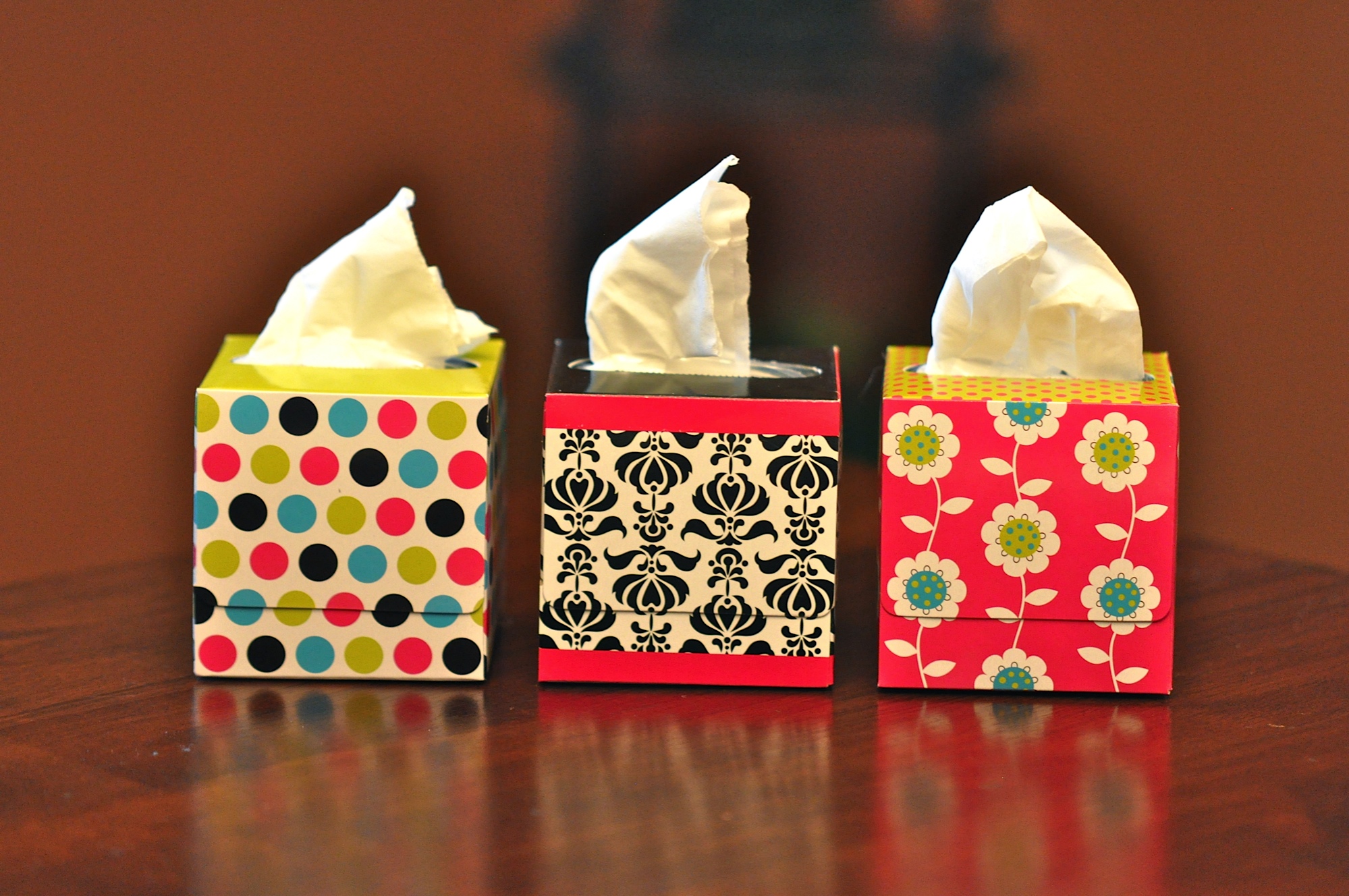
  • Tissue Boxes
  • Dishes
  •  Decorating
  • Ice cream
  • Coffee
  •  Bichons
  •  Target
  •  Paint chips
  • Color names
  • Pretty journals
  • Colored pens
  •  Mad Men (the TV show)
  • Naps
  • Writing
  • Psychology
  • Coming up with ideas
  • Quotes
  • Alliteration
  • Themes
  • Susan Cain’s work on introversion
  • Brene´ Brown’s work on shame
  • Sharon Salzberg’s work on meditation
  • Breathing
  • Kindness
  • SELF-COMPASSION

This is actually a really good exercise because I could write entire blog posts on many of these items.

I have the strong urge to put these in categories or make some kind of order out of them, but I’m going to resist and let it be. Hooray for me!

There’s Always More to Say

I highly recommend this course!

I’m taking an online writing class called Alchemy: The Art and Craft of Writing. The course is full of juicy stuff, but today I’m going to share what I wrote in response to a “writing prompt” (you write anything in response to a phrase provided by the teacher). The best part comes at the end with my teacher’s comments.

The prompt:What I want to say…

What I want to say is that I’m sad for myself how I turn something that was supposed to be “for me” (this writing class) into something that’s not fun (Oh yeah, why am I surprised? I’m the person who skipped the chapter on fun in The Happiness Project…) As I was reading part of the lesson this afternoon, I began to cry. (Again, why does this surprise me? I seem to have no shortage of tears.) My thoughts go like this: Why am I even taking this class? There is already so much great writing out there. The world doesn’t need another blog, or even another book. We’re already on information overload. Everything I might say has probably been said before.  I can argue with myself as I’m writing this, but the fact is, my initial reaction to many things is one of pessimism, of defeat. It’s always one of why I shouldn’t be doing something. I shouldn’t be taking this class because it’s frivolous. I shouldn’t be typing at the computer when it increases my pain level. I should be making dinner for my husband who works full-time and provides us health insurance. I should be getting more out of the class. I’m not putting enough into it. I should be commenting on other people’s writing more. This is B.S. (I don’t really cuss, but maybe I’ll start someday). I don’t really think these things are true. It’s just so automatic to go down this path. The grooves in my brain are deep. In a second I go from a cheery, “Oh, I’ll look at the computer to see what’s going on with my writing course today” to a tearful “I’m no good. I’m in pain. I shouldn’t be doing this right now.” No wonder the last therapist I saw asked me in the first ten minutes why I wasn’t on a mood stabilizer! Interesting how this week is on Using Your Voice and I’m trying to silence mine. I’m going to post this now without editing or looking back, but I think (No, I know) there’s more to be said.

My teacher, Jenna McGuiggan, wrote this in response: 

Barb, well I do cuss, so let me help you out for a minute: BULL SHIT to those naysayer gremlins in your head! (I’m really truly hoping you laugh here and are not offended.)

Thank you for sharing your thoughts and feelings here. I understand so very well the feeling of defeat that there’s nothing new under the sun. (Even the author of Ecclesiastes in the Old Testament of the Bible was bemoaning that fact!) And yet… there is only one of me. And only one of you. And no one sees the world like I do, or like you do. People don’t stop reading books or essays or blog posts, even if it’s all been said before in one way or another. And we shouldn’t stop writing, because until we write it, it hasn’t been said by us, in our unique way. Besides, writing is for you as much as for other people. I want people to read what I write, and I hope that they like it or are touched by it in some way, but I’ll always write, even if no one reads it. I write because it’s how I make sense of the world. I write because it makes me feel whole and more solid. I write because there is pleasure in having written.

May you acknowledge your pain and fear and doubt, and may you find a way to move alongside it, through it, and past it. I know you can.

Join the Club

Like many other people, I decided to enter an office lottery pool last week when the jackpot was at its record high. The person who spearheaded the group reported in an e-mail today that twenty people had entered, and we won a collective $19. In a flurry of e-mails, someone wrote, “Let’s make a ‘club’ and we’ll do this every week. Who’s in?” Once the word club was mentioned, I cringed. Ugh. I hate joining things.

I don't want to belong to any club that accepts people like me as a member. -Groucho Marx

I think it goes back to my college days when I joined a sorority, hoping to find a place where I didn’t feel like my usual misfit self. I was happy to be accepted, but soon learned it wasn’t for me. I had to wear my sorority shirt on a certain day each week. I had to go to parties at the frat houses every Wednesday or I’d be fined. I decided to quit, but this was no easy process.  I had to appear before the Board and make my case for leaving the sisterhood. I couldn’t even quit on my own.

Today, after work, I went to the local health food store. On the first Monday of the month, they offer 20% off of all supplements. The place was swamped with people, all looking for the perfect “natural” pill to take away their ailments. Or should I say “our” ailments?

I’ve written in other posts about my adventures in alternative medicine–trying to find some new ways to deal with my chronic pain. I guess I should be happy that the doctor I’m seeing is taking a holistic approach, but I feel like I’ve been thrown into this new world that seems quite foreign. I’ve never eaten that badly, but I’m a One-a-Day vitamin kind of girl, and I like my processed, easy-to-prepare foods. In addition to the various vitamins and supplements I’ve been prescribed, I’ve also been advised to follow a gluten-free, “Paleo Diet.” I’ve been experimenting with this way of eating since late January, but mostly with half-hearted attempts.  I do what I usually do: buy a few books, read them, and don’t fully do what they say. I decided that yesterday, being the first of the month and always a good time to start a new goal, I’d follow the eating plan in earnest. Well, I’ve made it almost two days. I’m hungry. I’m crabby. And I miss my carbs. But now, somehow, I’m part of some free-range chicken/organic produce/supplement-popping club.

Can I quit? Sure. Will I quit? I don’t know.

As I write this, I realize I belong to a very large club whether I want to or not. I’m part of the human club.

In her book Self-Compassion, Kristin Neff notes, “When we’re in touch with our common humanity, we remember that feelings of inadequacy and disappointment are shared by all. This is what distinguishes self-compassion from self-pity. Whereas self-pity says, ‘poor me,’ self-compassion remembers that everyone suffers, and it offers comfort because everyone is human.”

Even though my pain may be different than your pain, we have much in common.  As humans, we have imperfect bodies. Bodies that have aches and pains. Bodies that get old. Bodies that are impermanent (that’s Zen-speak for die).

Now there’s a cheery thought…